1. Core Idea: What is useReducer?
useReducer is a state management pattern based on pure functions and actions.
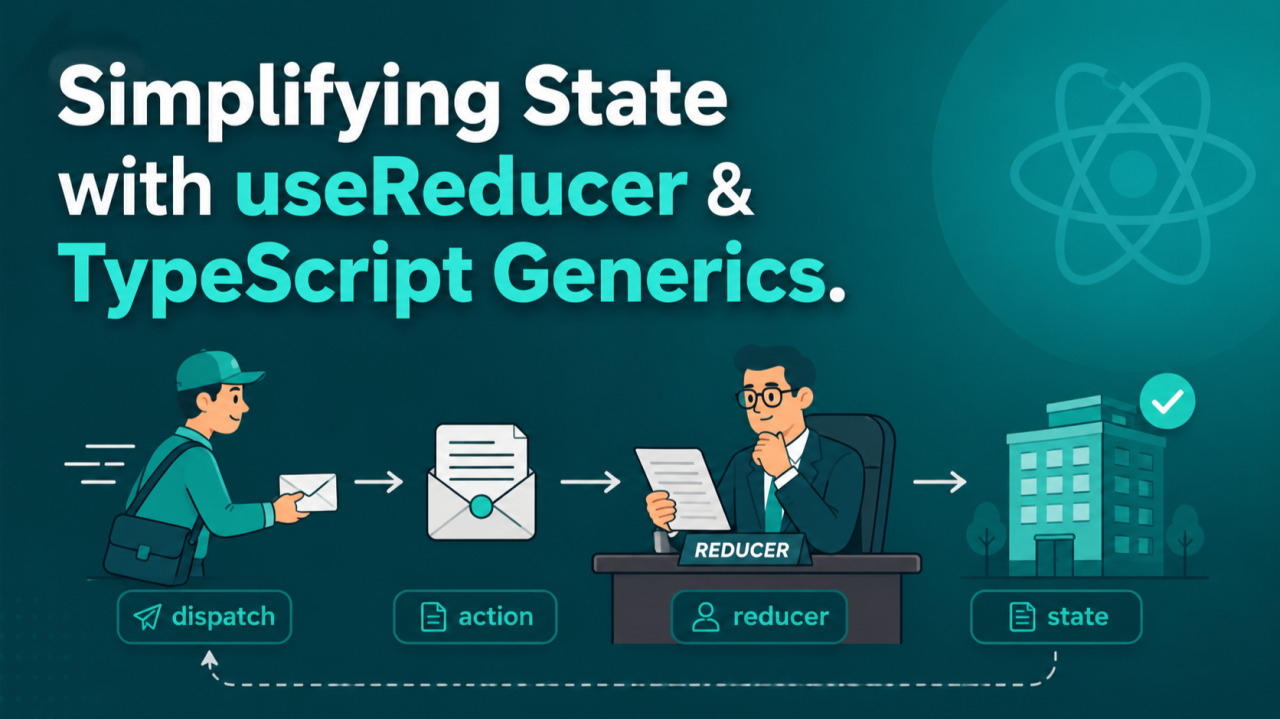
📮 dispatch (messenger)
↓ sends a letter (action)
👨💼 reducer (manager)
↓ decides what happens
🧾 state (company status)2. What is an Action? (The meaning of payload)
An action is a message describing what happened, plus optional data about it (the payload):
{
  type: "FETCH_SUCCESS",
  payload: products
}type→ the event name (what happened)payload→ the data carried with the event
📦 Think of the payload as the cargo inside a delivery box. It is not logic — it is data transport.
3. State (Generic Structure)
type State<T> = {
  data: T | null;
  loading: boolean;
  error: string | null;
};
T is an unknown data type (Product, User, Category…), so this state works for any API.
4. Action (Discriminated Union)
type Action<T> =
  | { type: "FETCH_START" }
  | { type: "FETCH_SUCCESS"; payload: T }
  | { type: "FETCH_ERROR"; payload: string };
Why a union type? Because the manager only understands three valid messages.
5. Reducer (Decision Engine)
function reducer<T>(state: State<T>, action: Action<T>): State<T> {
  switch (action.type) {
    case "FETCH_START":
      return { ...state, loading: true, error: null };
    case "FETCH_SUCCESS":
      return { data: action.payload, loading: false, error: null };
    case "FETCH_ERROR":
      return { ...state, loading: false, error: action.payload };
    default:
      return state;
  }
}
Mental model: state + action → reducer → new state.
6. Why Generics (<T>) Matter
Without generics, the code only works for Product[] and must be rewritten for every API. With generics, T is a type placeholder:
useFetch<Product[]>
useFetch<Category[]>
useFetch<User[]>
The same system adapts automatically.
7. The Full useReducer Flow
1. initialState
2. dispatch(FETCH_START)
3. reducer → loading = true
4. API call
5. dispatch(FETCH_SUCCESS)
6. reducer → data filled
7. UI updates
8. End-to-End Diagram
Component
   │
   ▼
dispatch({ type: "FETCH_START" })
   │
   ▼
Reducer → loading = true
   │
   ▼
API Request
   │
   ├── SUCCESS → dispatch(FETCH_SUCCESS) → data = result
   │
   └── ERROR → dispatch(FETCH_ERROR) → error message
9. Senior-Level Insight
useReducer is not just state management. It is a finite state machine where actions are events, the reducer holds the transition rules, and the state is a snapshot of the system.
10. Why Payload Is Critical
Without a payload you can only say "something happened". With a payload you can transfer real data through events. FETCH_SUCCESS without a payload is useless; with a payload it becomes a meaningful state update.
11. Final Mental Model
- 📮 dispatch = send a message
- 📄 action = message + optional data (payload)
- 👨💼 reducer = decision maker
- 🧾 state = final result
<T>= a flexible type system for reuse
Example repository: react-learning-journey on GitHub